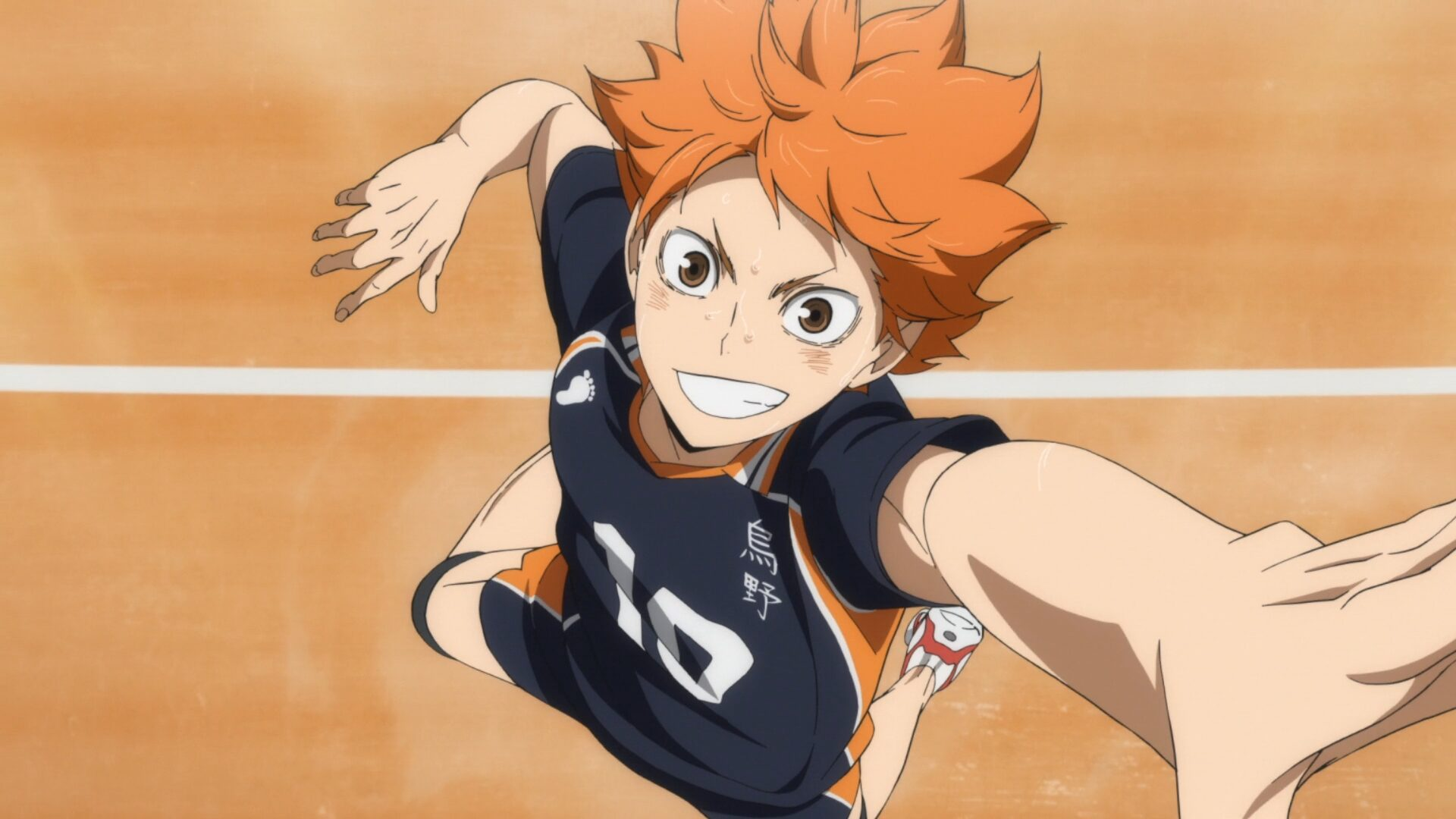

The adrenaline rush, the pounding heart, the shaky legs, and the nervous anticipation that wracks your body while sitting on the edge of your seat, watching two teams fight neck and neck, are all too familiar. And then comes the final yelp when the protagonist pulls off his signature move against the opposing team, finally releasing the breath you didn’t realize you were holding. If you watch sports anime, then this must sound like a routine part of every match, yet somehow, we never seem to get bored.
Haikyuu!! written and illustrated by Haruichi Furudate, is among one of the anime where people revere the sportsmanship shown throughout the series. The story follows Shoyo Hinata and his quest to be the next little giant of volleyball. The main plot of the anime starts when Hinata joins Karasuno High, the same school where his role model, the Little Giant played. While checking out the school’s volleyball club, he meets Tobio Kageyama, his rival whom he lost to in middle school as well as the setter who would allow Hinata to realize his full potential. Throughout the anime, Hinata comes across various hurdles due to his height when facing players way taller than him opposite the net, but each time he wastes no time proving that he is fit to be on the court.
Hinata is the epitome of hard work; the boy built his stamina by cycling every morning from his house to school, which takes 30 minutes just one way! His stamina plays a crucial role in the plays against other teams. It would be foolish to pin all credit on Kageyama in their famous quick attack. Although the attack is set by Tobio, without Hinata’s full trust, jump, agility, speed, and stamina, it just wouldn’t work out. Which is why I disagree with Shiratorizawa coaches’ words to Hinata when he crashed Miyagi Prefecture training camp in season 4: “Without that setter, Kageyama, I can’t say that I sense any worth in you.”
Contrary to his words, I fully believe that both Hinata and Kageyama helped each other grow and bring forth each other’s potential.
How High Can Hinata Jump?
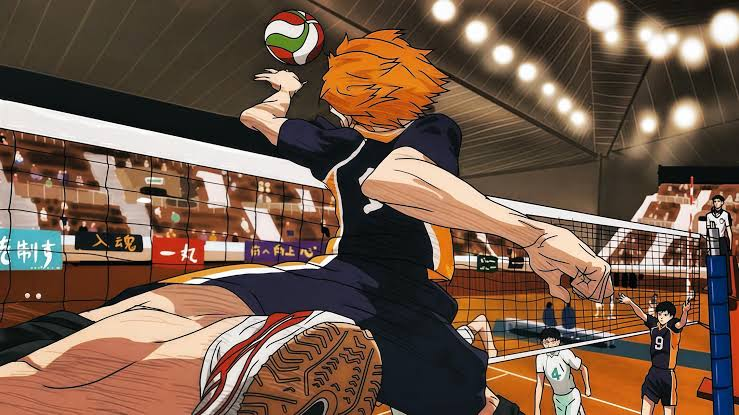
Although Hinata’s height puts him at a disadvantage when compared to other players, his jumps never failed to astonish anyone who witnessed them. Hinata can jump high, but how high is the question. Upon entering Karasuno High, Hinata is listed to be around 162.8 cm tall (while growing to 164.2 in the same year), while his fingertip height when standing is given to be 210 cm. In Haikyuu!! To the top, the volleyball club takes measurements of the maximum spike height of all the club players, and Hinata’s spike height was measured to be 333 cm.
Although Hinata lost his bet with Kageyama in that episode, whose spike height came to 337 cm, it is still an impressive reach for a person of Hinata’s height. Although Hinata reaches 175 cm by the time he becomes an adult (his spike height reaching 350 cm), in this article we will only be discussing his jump height during the time he was in Karasuno High, primarily during his first year. So, calculating his vertical jump from the above specifics (333 cm – 210 cm = 123 cm/48 inches), his vertical jump would be roughly 48 inches, which is discussed very often in the Haikyuu!! threads on Reddit and X.
Breaking Down Karasuno’s 9 & 10 Quick Attack.
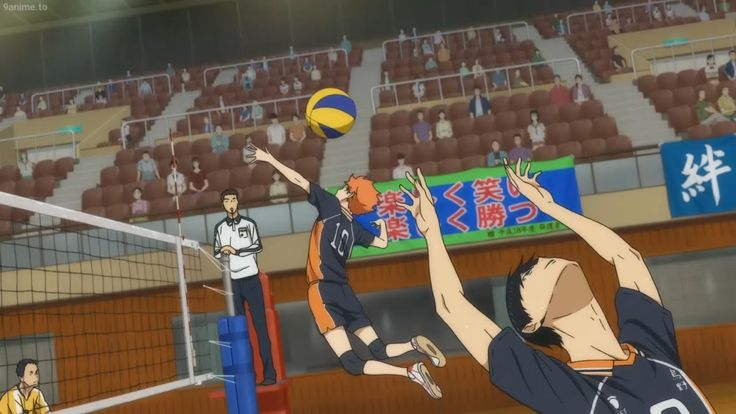
Hinata and Kageyama’s quick attack, where the latter sets the ball and the former spikes it, is a coordinated attack. Initially, the setter sets the ball with calculated accuracy, and the spiker hits the ball with speed, momentum, and trust. The first time we see this is when Hinata and Kageyama were desperately trying to prove that they are fit for the volleyball club after a series of incidents. During the 3-on-3 match, after many unsuccessful attempts, they finally hit a quick, but to the surprise of others, Hinata’s eyes were completely closed when striking the ball. Throughout season 1, he had his eyes closed; only in season 2 does Hinata desire to move away from completely depending on Kageyama for strikes and use his own skills to strike when there are blockers ahead.
The quick attack started as something Kageyama completely controlled while using Hinata as a weapon to hit the difficult sets. Although Kageyama sets the ball to where he calculates Hinata might jump, it would be difficult to hit those sets without Hinata’s speed, agility, and high jump. Later in season 2, he finally learns to strike while making judgments for himself, making the quick even more dangerous to his opponents.
Throughout the manga and anime, his characteristic jump has not failed to impress his peers and opposing players. Although Hinata lacks explosive power (like Asahi and Ushijima), he has explosive speed.
To explain in technical terms, a jump consists of two things: how quickly you can generate force and how much force you can generate, and Hinata is best at creating this said force quickly. Coming to a spike jump, it also broadly contains two parts: the approach phase and the takeoff phase. During the approach phase, the player generates horizontal velocity; the horizontal velocity is converted to vertical velocity in the takeoff phase. The quality of the conversion determines how high one can jump when spiking. Hinata is able to do both phases efficiently, which explains why he can jump high.
For me personally, my favorite high jump of Hinata is during the Tokyo Expedition Arc. After preparing for their exams in Yachi’s house, both Kageyama and Hinata meet Ushijima on their way back home. They ask him if they could watch a match of the Shiratorizawa volleyball team. After the match, as they were talking, Ushijima states that Oikawa is wasting his skills at Aoba Johsai, as his teammates are weak. To which Hinata responded, “Weak… If Seijoh is infertile soil, are we concrete or something?” Just then, a ball came out of the practice ground. Before Ushijima could grab it, Hinata jumped and grabbed the ball, surprising Ushijima in the process.
Can Real Life Players Come Close to Hinata’s Impossible Like Jump?

To make the comparison fair, we will only compare volleyball players throughout the world. An important thing to note is that although mimicking Hinata’s jump height is not impossible, it is unheard of for someone of Hinata’s height to jump that high. Especially, considering that in the series, Hinata is a high school boy who is still growing and isn’t as experienced as the players mentioned below.
- Matey Kaziyski, a 6’8″ (203 cm) Bulgarian outside hitter, has been credited with one of the highest recorded spike touches in the sport, reportedly around 390 cm. 2. Leonel Marshall, a Cuban hitter listed at 6’5″ (196 cm), has posted a spike reach in the 380 cm range and is often cited as one of the most explosive jumpers in the sport relative to his height.
- Dmitriy Muserskiy is listed at 218 cm tall, with a 375 cm spike reach. 4. Wilfredo León, a Cuban-born Polish player has a height of 201 cm, with his spike height reaching 365cm.
- Paola Egonu, a sportswoman from Italy is regularly cited with a spike reach around 344 cm, among the highest in the women’s game.
To answer the question, if real life players can jump as high as Hinata? Yes. But if you take a closer look at all the examples, each one of the players is taller than Hinata. The height of the players definitely helps them to jump high, so if we are only considering the vertical jump of the players, no real player comes close to Shoyo Hinata. To simply put, attaining the same spike height isn’t impossible, but attaining it under the same conditions as Hinata
is yet to be done by any living human. I believe that is where we draw the line between fiction and reality.
Regardless of that, Haikyuu!! surely inspired many young people to play volleyball and fall in love with the sport. Don’t blame me if you want to jump like Hinata or set like Kageyama if this article is the reason you watch Haikyuu!! But if you’re like me, waiting for the next Haikyuu!! season to release, then occupy your time with a collection of awaited releases coming this year.
Frequently Asked Questions (FAQs)
1. How High Can Hinata Jump in Haikyuu?
As a first-year at Karasuno, Hinata is listed at around 162.8 – 164.2 cm tall, while his maximum spike reach is approximately 333 cm. This gives him an exceptional reach difference of about 123 cm (or 48 inches).
2. How does Hinata’s quick attack with Kageyama work?
Hinata’s original quick attack relies on extraordinary timing between him and Kageyama. Hinata begins his approach and jumps without needing to watch the ball, while Kageyama delivers the set to the exact point where Hinata’s hand will meet it. Their combination is so fast that opposing blockers have very little time to react. As Hinata develops, he learns to keep his eyes open, allowing him to see the ball and read the blockers instead of relying entirely on Kageyama.
3. Why can Hinata jump so high despite being short?
Hinata’s jumping ability comes from more than his height. His biggest advantages are his explosive lower-body power, speed, coordination, timing and approach technique. His fast approach allows him to generate momentum before takeoff, while his exceptional athleticism helps him convert that movement into a powerful jump. His height may be a disadvantage at the net, but his speed and jumping ability allow him to compensate for some of that difference.
4. Is Hinata’s jump physically possible in real life?
Hinata’s jumping ability is… safe to say an exaggerated version of athletic qualities that real volleyball players possess. Elite volleyball players can achieve remarkable attack and block reaches through a combination of height, arm length, approach speed, and jumping ability. However, Hinata’s exact fictional performance should not be interpreted as a directly measured real-world vertical jump.
5. When is the next Haikyuu!! season coming out?
There is currently no new TV season announced as the next release. Instead, the continuation is coming in 2027 through two animated projects: the movie Haikyuu!! The Movie: VS the Little Giant, which covers Karasuno’s match against Kamomedai, and the special anime Haikyuu!! Bakemono-tachi no Yuku Tokoro in Japanese—which covers Fukurodani vs. Mujinazaka. Both were officially announced for 2027, although an exact release date has not yet been announced.


Leave a Comment